Rancho Cowboy: A Vintage Serif Font That Feels Like Home
There’s a quiet magic in the moment you type “Wild Sage Candle” into your design software—and then swap in Rancho Cowboy. Suddenly, the label isn’t just functional. It’s warm. It’s grounded. It carries the hush of sun-baked wood, the soft creak of a porch swing, the kind of quiet confidence that doesn’t shout—but still holds your gaze.
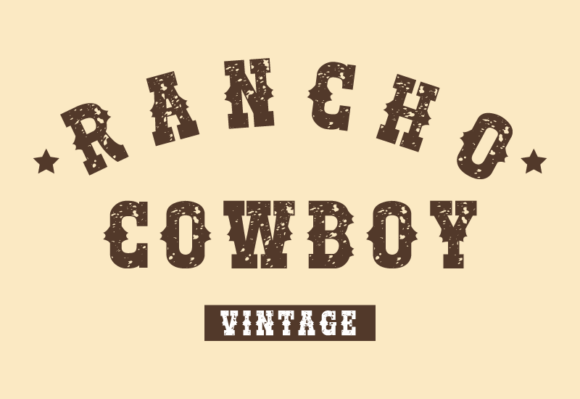
I was testing it on a set of small kraft sticker sheets for herbal tea blends—just names like “Desert Mint” and “Juniper Trail”—and realized how effortlessly Rancho Cowboy bridges rustic charm with clean legibility. It’s not overly ornate, but it’s never plain. As a serif font, its subtle strokes and gentle contrast give it presence without stiffness. Think of it as the friendly neighbor who wears boots to the farmers’ market and knows exactly how to hang a sign so it catches the light just right.
This is a display font built for real making—not just mood boards. I’ve used Rancho Cowboy for candle labels printed on matte sticker paper, wedding welcome signs laser-cut from birch, printable wall art for farmhouse-style nurseries, and even the subtle “Hand-poured • Small Batch” line on my soap packaging. Its western touch comes through in the slight flare of its serifs and the relaxed rhythm of its letterforms—not cartoonish, not cliché, but quietly evocative.
What makes it especially useful for handmade sellers? It works beautifully at small sizes (I’ve used it confidently down to 8pt on 1”-wide boutique tags) and holds up well when cut on Cricut or Silhouette machines—no fragile terminals or thin hairlines that vanish mid-cut. For digital downloads, it adds instant personality to planner pages, greeting card templates, and seasonal printables like “Fall Harvest” checklist sheets or “Ranch Life” journal covers. Because it’s a single-weight serif font, it shines brightest where intention matters most: headlines, titles, names, short phrases, and decorative text—not long paragraphs.
When designing physical goods, I always test readability first. On mugs? Yes—especially with a crisp white or cream background. On black cotton tote bags? Absolutely, if paired with a slightly larger size and generous letter spacing. On kraft paper gift tags? Perfect—its warmth complements natural textures without competing. And for wedding stationery? I’ve layered it over watercolor backgrounds for invitation suites, using it only for names and dates—letting its vintage elegance do the talking while keeping body text in a clean sans serif for clarity.
Speaking of pairing—it’s where Rancho Cowboy truly sings. I often pair it with a neutral sans serif like Montserrat or Lato for contrast and balance: Rancho Cowboy for the headline (“Welcome to the Ranch”), the sans for details (“Saturday, October 12 • 4 PM”). For a softer look, I’ll use it alongside a delicate script font for names—never competing, always complementing. It also grounds bolder display fonts in shop signage or social media graphics, adding warmth where others might feel cold or corporate.
One thing I always check before finalizing any product file: the included font files. Rancho Cowboy comes as a standard OTF/TTF package—no extra weights or stylistic sets, which keeps things simple for crafters who want consistency without complexity. It supports basic Latin characters and common punctuation, so it’s ideal for English-language shop branding, greeting cards, and printable templates. Just remember to verify commercial licensing before bundling it into SVG cut files, editable Canva templates, or digital downloads sold on Etsy or Gumroad—most reputable font vendors include clear terms for physical and digital resale use.
I’ve used it for holiday collections too—think “Merry & Bright” on red-and-cream gift tags, or “Gather ‘Round” on wooden serving board stencils. Its timeless quality means it doesn’t date quickly; last year’s “Summer Solstice” candle label feels just as fresh this June as it did in May. That kind of longevity matters when you’re building a cohesive brand identity across seasons, products, and platforms.
For printable creators, it’s become my go-to for editorial-style layouts—like a “Slow Living” planner spread where Rancho Cowboy anchors the title and a minimalist serif handles subheads. Its character gives digital products a handcrafted soul, even when delivered as PDFs. And for anyone designing shop banners or listing images? It adds visual weight and authenticity fast—no need for elaborate graphics when the typography itself tells part of your story.
It’s not flashy. It won’t mimic neon or graffiti or futuristic chrome. But Rancho Cowboy has something rarer: sincerity. It feels honest. Thoughtful. Made with care. And in a world of endless fonts chasing trends, that kind of grounded, western-inspired serif font stands out—not by shouting, but by staying.
If you're choosing a typeface to represent your handmade work—the kind that values texture over trend, warmth over wow—Rancho Cowboy doesn’t just sit on the page. It settles in. Like dust on an old bookshelf. Like leather on a favorite chair. Like home.